
 +91 90540 90590
 connect@roblinx.com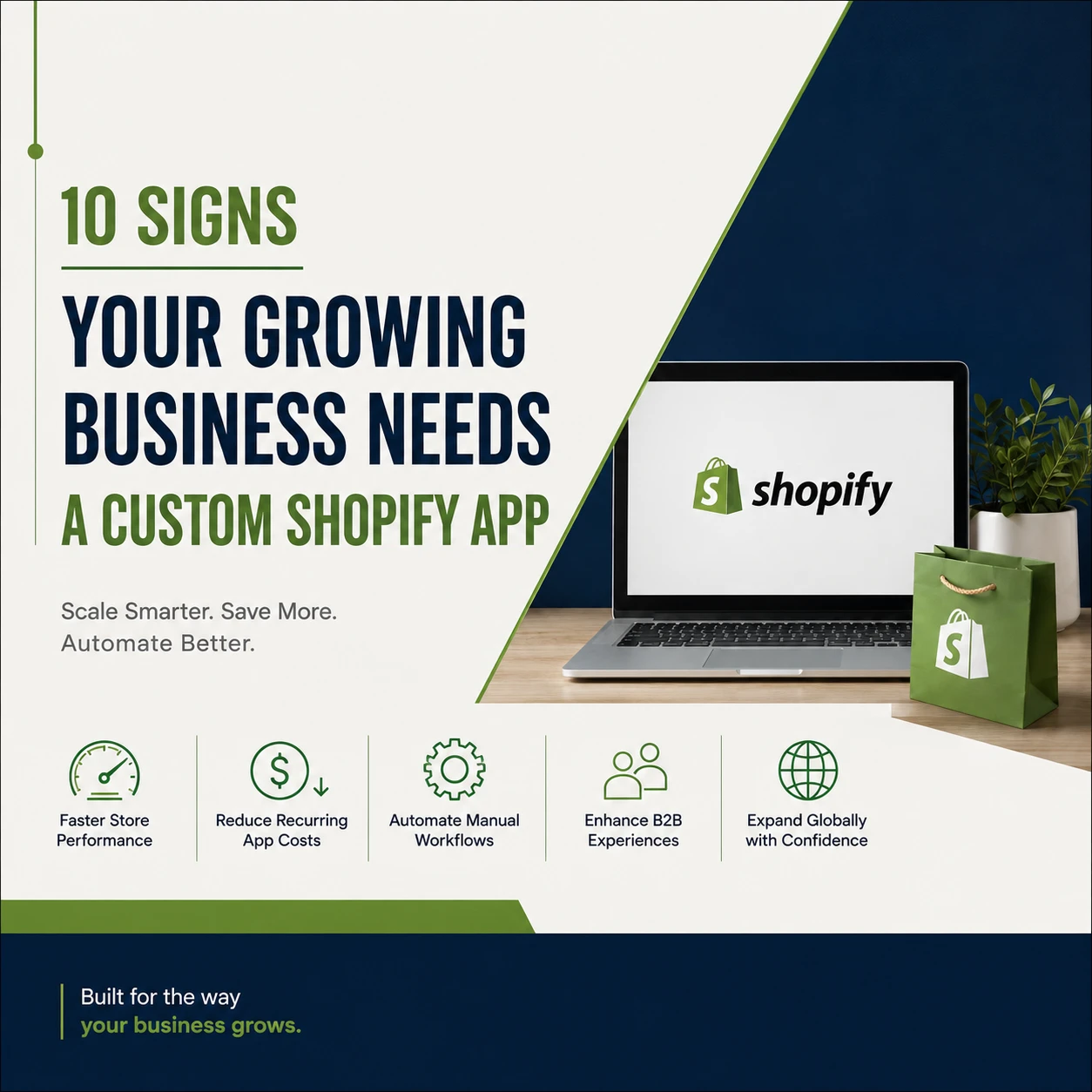
When launching an e-commerce brand, the Shopify App Store is an invaluable resource. Off-the-shelf plugins offer quick, accessible solutions for capturing emails, showing customer reviews, or setting up basic subscription tiers. They allow founding teams to validate ideas quickly without spending months on initial software development.
However, as order volumes surge, product catalogs expand, and operations become more intricate, generic plugins can reach their natural limits. Pre-built apps are designed for the average merchant, not for high-volume brands managing unique B2B logic, multi-warehouse inventory, or complex backend workflows.
Transitioning to custom-built software isn't about discarding third-party tools entirely—it is about evolving your digital infrastructure when off-the-shelf plugins start creating operational friction. Here are 10 clear indicators that your business is ready for a custom Shopify application engineered specifically around your workflows.
1. Checkout Speeds Drop During Traffic Surges
Every third-party app installed on a storefront injects external JavaScript files, stylesheets, and tracking scripts into your theme. Over time, these scripts accumulate, creating bloated code structures that delay page rendering.
According to Deloitte and Google's Milliseconds Make Millions study, a mere 0.1-second improvement in mobile site speed can boost e-commerce conversion rates by 8.4%. When multiple external apps attempt to execute code simultaneously during a major sales event, site responsiveness suffers, leading directly to abandoned carts.
Traditional App Stack vs. Custom Infrastructure
-
Standard Pre-Built Stack: Installs 10–15 separate third-party scripts, creates render-blocking browser assets, relies on external app servers, and introduces unpredictable latency spikes.
-
Custom App Setup: Consolidates logic into a single server-side application, utilizes native Storefront API endpoints, and maintains consistent sub-100ms load times.
The Solution
Instead of relying on heavy client-side scripts, a custom application built by a specialized Shopify development company leverages native Shopify Functions and WebAssembly (Wasm). By executing custom logic server-side on Shopify's global infrastructure, your site avoids client-side clutter and maintains fast load times for every shopper.
If you are evaluating your overall digital footprint, learning how clean backend code protects speed is central to modern web application development services.
2. Your Monthly SaaS App Subscription Costs Are Adding Up
In the early stages of a business, spending $20 to $50 per month per app is an economical choice. But as your store scales onto Shopify Plus, third-party pricing structures shift. App developers routinely migrate high-volume stores onto enterprise pricing tiers calculated as a percentage of overall revenue or total order counts.
It is common for scaling merchants to pay $2,000 to $6,000+ every month across a patchwork of 10 to 15 third-party plugins. Over a two-year period, that represents up to $144,000 in recurring rental fees for software your business will never own.
Why Custom Wins
Building proprietary software requires an upfront engineering investment, but it transforms a recurring operational expense into a permanent business asset. By replacing 4 or 5 high-cost subscription plugins with a single, dedicated app, the project often pays for itself within 12 to 18 months while eliminating recurring software taxes.
3. Operations Teams Are Trapped in Manual CSV Data Transfers
Consider a typical mid-market scenario: Your fulfillment team spends two hours every evening exporting sales reports from Shopify as CSV files, reformatting column headers manually in Excel, and uploading them into an external Enterprise Resource Planning (ERP) or Inventory Management System (IMS).
As daily orders grow from dozens to thousands, even a single transposed digit or failed spreadsheet import can lead to stock overselling, delayed shipments, and frustrated customers.
How a Custom App Helps
A custom app acts as an automated operational bridge. Utilizing background webhooks and secure Shopify API integration, the app automatically synchronizes order statuses, stock adjustments, and customer records between Shopify and your external systems in real time—completely eliminating human data-entry errors.
4. Complex B2B and Wholesale Workflows Break Standard Checkouts
B2B buyer behavior has evolved rapidly. Reports show that 65% of B2B companies now offer e-commerce capabilities, yet standard online checkout flows are designed primarily for single retail transactions.
Standard wholesale plugins often struggle when your business requires:
-
Tiered pricing matrices tied to historical annual purchasing contracts.
-
Flexible payment terms (such as Net 30 or Net 60) validated via instant credit limits.
-
Minimum order quantities (MOQs) that adjust dynamically based on live regional warehouse stock.
-
Account-specific catalog permissions for corporate franchises.
A Better Approach
Using Shopify Plus development techniques, custom apps inject tailored business logic directly into the native checkout pipeline. Wholesale buyers receive personalized pricing and corporate payment terms within a single, unified purchasing portal.
5. Standard Dropdowns Fail for Custom or Personalized Products
If your store sells modular furniture, tailored apparel, customizable gift boxes, or industrial machinery, standard dropdown fields and basic variant limits quickly run out of functionality.
|
Feature Need |
Standard Product Plugin |
Custom Shopify App |
|
Logic & Options |
Basic dropdowns; static rules |
Unlimited nested conditional logic |
|
Visual Rendering |
Static image swaps |
Interactive 2D/3D live preview canvas |
|
Fulfillment Data |
Raw text notes in line items |
Print-ready vector assets & ERP manufacturing specs |
|
Checkout Sync |
Dynamic price delays |
Instant server-side price updates |
What You Gain
A custom product builder gives customers complete creative control through interactive live previews while automatically generating precise manufacturing blueprints for your production team.
6. You Suffer Layout Conflicts Between Multiple Third-Party Tools
Standard public plugins are built to work on thousands of different Shopify themes. To achieve this broad compatibility, they inject style overrides and DOM manipulators directly into your frontend theme code.
When multiple plugins attempt to modify the same page elements, such as a sticky cart button or slide-out cart drawer—layout shifting, broken buttons, and visual bugs occur. Studies show that roughly 18% of online shoppers abandon carts due to site errors and visual glitches.
The Engineering Advantage
Custom apps operate within isolated Shopify Theme App Extensions. Because they are engineered exclusively for your exact theme codebase, future theme updates or visual brand refreshes will never cause third-party plugin conflicts.
If you want to ensure your custom apps integrate smoothly with your core storefront design, explore our full suite of custom product engineering solutions.
7. Order Processing Slows During Product Launches
High-demand product drops, flash sales, and holiday shopping surges generate sudden spikes in API requests. Standard public apps operate on multi-tenant servers, meaning their API quotas are shared across thousands of other merchants simultaneously.
During peak traffic events, third-party server bottlenecks can cause delayed cart updates, failed discount redemptions, or dropped stock synchronization right when sales volume is highest.
The High-Volume API Architecture
Custom architecture handles these traffic drops through three structured steps:
-
The Trigger: High-volume traffic events channel data straight through the high-throughput Shopify GraphQL Admin API.
-
The Infrastructure: Dedicated cloud instances (like AWS or GCP serverless workers) instantly scale up to manage incoming requests.
-
The Synchronization: Real-time queue processing handles transactions immediately, updating your ERP and WMS instantly without dropped data.
The Solution
Custom applications bypass shared public servers by connecting directly using dedicated, auto-scaling cloud infrastructure. This ensures your system handles thousands of concurrent checkouts effortlessly without hitting multi-tenant rate limits.
8. Generic Loyalty Tools Limit Retention Strategies
Standard retention plugins offer basic point structures (e.g., earn 10 points for every $1 spent). However, standing out in competitive markets requires personalized engagement loops that basic loyalty apps cannot accommodate out of the box.
Innovative brands often require custom loyalty logic, such as:
-
Rewarding non-transactional customer behaviors (such as uploading product fit videos or completing style quizzes).
-
Unlocking surprise mystery gifts automatically on a customer's third subscription order.
-
Dynamic cart drawer progress bars showing live milestones toward VIP status.
The Custom Benefit
Tailored Shopify app development allows you to build proprietary loyalty and reward engines designed around your exact customer lifecycle, driving higher customer lifetime value (LTV) without compromise.
9. Managing Multi-Warehouse Inventory and Bundles
Product bundling is a proven strategy to increase Average Order Value (AOV). However, managing component inventory across multiple physical fulfillment centers is notoriously difficult for generic bundling apps.
When a customer purchases a "Build Your Own Kit," your warehouse needs individual pick lists for each SKU, and your database must decrement stock levels for every individual item across specific regional fulfillment nodes in real time.
Why Custom Wins
A custom app utilizes Shopify's Cart Transform API to automatically split bundles into individual component SKUs at the exact moment of checkout. This guarantees accurate pick lists for warehouse staff and prevents accidental overselling across locations.
10. Expanding Internationally Across Multiple Regions
Expanding globally introduces complex multi-currency, multi-language, and regional compliance requirements that basic plugins struggle to coordinate smoothly.
Global e-commerce brands require tailored orchestration for:
-
Dynamically displaying localized pricing and currency conversion without layout shift.
-
Intelligently routing orders to the nearest regional fulfillment center based on live stock levels and local shipping rates.
-
Enforcing regional privacy policies aligned with official compliance frameworks for international shoppers.
A custom app serves as a centralized international manager, handling currency switching, order routing, and localized compliance behind the scenes so your international buyers enjoy a seamless local shopping experience.
Custom Shopify App Development: Scope & Timeline Breakdown
When planning a custom development project, understanding scope and investment tiers helps align engineering efforts with business goals:
|
Project Scope |
Key Deliverables |
Average Timeline |
Business Focus |
|
Targeted Utility App |
Single-purpose automation, custom admin workflows, theme extensions. |
3 to 5 Weeks |
Automating repetitive, manual internal tasks. |
|
Workflow Integration App |
Custom product builders, B2B wholesale portals, ERP/IMS sync tools. |
6 to 10 Weeks |
Eliminating app stack bloat and automating supply chains. |
|
Enterprise Platform App |
Multi-system orchestration, dynamic multi-region routing, custom loyalty engines. |
12+ Weeks |
High-volume operational infrastructure for scaling brands. |
Frequently Asked Questions
When should a business consider building a custom Shopify app?
A business should consider custom Shopify app development when third-party plugins begin causing slow page loads, incurring high monthly subscription fees, failing to sync with internal systems (like ERPs or CRMs), or lacking support for unique business workflows like advanced B2B pricing.
How much does custom Shopify app development cost?
Custom Shopify app development typically ranges from $8,000 to $18,000 for targeted utility tools, $20,000 to $45,000 for mid-level workflow apps (like custom product configurators or ERP integrations), and $50,000+ for enterprise-level operational platforms.
Can a single custom app replace multiple third-party Shopify apps?
Yes. A primary benefit of custom Shopify development is consolidating multiple single-purpose plugins into one unified application. This reduces monthly app subscription bills, eliminates client-side code bloat, and prevents theme layout conflicts.
Does Shopify Plus require custom apps?
While Shopify Plus includes advanced features out of the box, high-volume merchants on Shopify Plus frequently use custom apps to connect complex legacy infrastructure, build custom checkout rules via Shopify Functions, and handle high-volume B2B catalog management.
How long does it take to develop a custom Shopify app?
Development timelines vary based on project complexity. Simple utility apps take approximately 3 to 5 weeks, while complex integrations involving custom databases, multi-system data syncs, or advanced configurators typically take 6 to 12 weeks.
Will a custom Shopify app work if I change my store theme in the future?
Yes. Modern custom apps are built using Shopify Theme App Extensions. This decouples the app's backend logic from your frontend presentation layer, ensuring your app continues to function seamlessly even if you update or redesign your store theme later.
Streamline Your E-Commerce Architecture
Pre-built Shopify plugins are an excellent choice for launching and validating an online store. However, when unique business rules, high order volumes, or multi-system workflows demand a tailored approach, proprietary software provides the performance, stability, and control required to scale confidently.
If you are managing multiple overlapping apps, struggling with manual processes, or preparing your store for its next stage of growth, a custom Shopify app can simplify your operations and lower long-term costs.
Our team helps growing brands design, engineer, and deploy scalable Shopify solutions tailored precisely to their workflows. Contact Roblinx today for a consultation and discover how custom software can optimize your store.